


 一键配货
一键配货
化合物详情
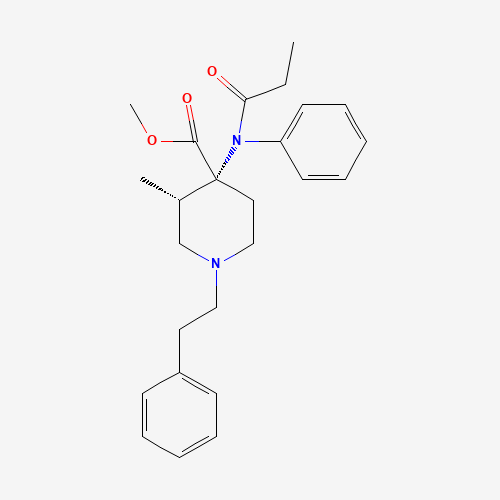
CAS61380-40-3
分子式C24H30N2O3
分子量408.5332 g/mol
非危品
Lofentanil is an analog of fentanyl and is one of the most potent opioids available today. It displays most similarity to carfentanil (4-carbomethoxyfentanyl) and is considered to be slightly more potent than this drug.
科学粮草官-词典编辑部,修订于:2026-07-06
Toxicity
ToxicityFate Summary
ATMOSPHERIC FATE: According to a model of gas/particle partitioning of semivolatile organic compounds in the atmosphere(1), lofentanil, which has an estimated vapor pressure of 3.5X10⁻¹⁰ mm Hg at 25 °C(SRC), determined from a fragment constant method(2), is expected to exist solely in the particulate phase in the ambient atmosphere. Particulate-phase lofentanil may be removed from the air by wet and dry deposition(SRC). Lofentanil contains chromophores that absorb at wavelengths >290 nm(3) and, therefore, may be susceptible to direct photolysis by sunlight(SRC).
Soil Adsorption / Mobility
Using a structure estimation method based on molecular connectivity indices(1), the Koc of lofentanil can be estimated to be 30,000(SRC). According to a classification scheme(2), this estimated Koc value suggests that lofentanil is expected to be immobile in soil. The estimated pKa of lofentanil is 8.36(3), indicating that this compound will exist partially in the cation form in the environment and cations generally adsorb more strongly to soils containing organic carbon and clay than their neutral counterparts(4).
Environmental Bioconcentration
An estimated BCF of 280 was calculated in fish for lofentanil(SRC), using a log Kow of 4.22(1) and a regression-derived equation(2). According to a classification scheme(3), this BCF suggests the potential for bioconcentration in aquatic organisms is high, provided the compound is not metabolized by the organism(SRC).
Volatilization from Water / Soil
An estimated pKa of 8.36(1) indicates lofentanil will exist partially in the cation form at pH values of 5 to 9 and, therefore, volatilization of the cation from water and moist soil surfaces is not expected to be an important fate process(SRC). The Henry's Law constant for lofentanil is estimated as 5.8X10⁻¹³ atm-cu m/mole(SRC) using a fragment constant estimation method(2). This Henry's Law constant indicates that neutral form of lofentanil is expected to be essentially nonvolatile from water and moist soil surfaces(3). Lofentanil is not expected to volatilize from dry soil surfaces(SRC) based upon an estimated vapor pressure of 3.5X10⁻¹⁰ mm Hg(SRC), determined from a fragment constant method(2).
Environmental Abiotic Degradation
A base-catalyzed second-order hydrolysis rate constant of 1.4X10⁻⁶ L/mole-sec(SRC) was estimated using a structure estimation method(1); this corresponds to half-lives of 160,000 and 16,000 years at pH values of 7 and 8, respectively(1). Lofentanil contains chromophores that absorb at wavelengths >290 nm(2) and, therefore, may be susceptible to direct photolysis by sunlight(SRC).
Artificial Pollution Sources
Lofentanil's production and administration as an analgesic(1) may result in its release to the environment through various waste streams(SRC).
Probable Routes of Human Exposure
Occupational exposure to lofentanil may occur through dermal contact with this compound at workplaces where lofentanil is produced or administered. Exposure to lofentanil among the general population may be limited to those administered the drug or its use as an illicit drug. (SRC)
Environmental Fate / Exposure Summary
Lofentanil's production and administration as an analgesic may result in its release to the environment through various waste streams. If released to air, an estimated vapor pressure of 3.5X10⁻¹⁰ mm Hg at 25 °C indicates lofentanil will exist solely in the particulate phase in the atmosphere. Particulate-phase lofentanil will be removed from the atmosphere by wet and dry deposition. Lofentanil contains chromophores that absorb at wavelengths >290 nm and, therefore, may be susceptible to direct photolysis by sunlight. If released to soil, lofentanil is expected to have no mobility based upon an estimated Koc of 30,000. The estimated pKa of lofentanil is 8.36, indicating that this compound will exist partially in the cation form in the environment and cations generally adsorb more strongl...
Toxicity Summary
IDENTIFICATION AND USE: Lofentanil is a very potent opioid analgesic. It is used clinically in the management of pain. However, the high analgesic potency of this drug is limited by the development of tolerance after chronic use. HUMAN STUDIES: In patients side effects of very low incidence included nausea, vomiting and sedation. Another study mentions drowsiness in three patients as a side effect. ANIMAL STUDIES: Increasing doses of lofentanil (0, 0.08, 0.16, 0.31, 0.63, 1.25, 2.50, 5.00, and 10.0 ug/kg) were administered intravenously to rats to examine the relationship among central nervous system (CNS) depressant dosage, degree of analgesia (inhibition of tail withdrawal reflex), anesthesia (no response to bone-crush injury), and CNS opiate-receptor occupancy. Increasing doses of lo...
Human Toxicity Excerpts
/HUMAN EXPOSURE STUDIES/ The efficacy and safety of IM lofentanil, the most potent morphinomimetic drug available, for rapid control of postoperative pain was compared with IM piritramide and placebo in a study of 120 patients. Piritramide 7.5 mg and 15 mg, lofentanil 0.25 micrograms, 0.50 micrograms and 0.75 micrograms had a rapid onset of analgesic effect. Significant differences in pain intensity and pain relief when compared to placebo were observed at each observation period for each drug. Piritramide 15 mg is significantly more effective at 4, 5 and 6 hours when compared to lofentanil 0.75 micrograms, thus having a longer lasting effect than lofentanil 0.75 micrograms. There were no significant differences in pain relief between the different doses of lofentanil or between the dif...
Non-Human Toxicity Excerpts
/OTHER TOXICITY INFORMATION/ Increasing doses of lofentanil (0, 0.08, 0.16, 0.31, 0.63, 1.25, 2.50, 5.00, and 10.0 ug/kg), a potent long-acting narcotic, were administered intravenously to rats to examine the relationship among narcotic dosage, degree of analgesia (inhibition of tail withdrawal reflex), anesthesia (no response to bone-crush injury), and central nervous system (CNS) opiate-receptor occupancy (inhibition of (3)H sufentanil binding). Our results demonstrate that increasing doses of lofentanil produce increasing analgesia and anesthesia and eventually complete opiate receptor occupancy. Analgesia occurs with doses of lofentanil (0.31 ug/kg) that result in levels of CNS opiate-receptor binding too low to be measured and anesthesia occurs with doses of lofentanil (1.25 ug/kg)...
Antidote and Emergency Treatment
Emergency and supportive measures. 1. Maintain an open airway and assist ventilation if necessary. Administer supplemental oxygen. Treat coma, seizures, hypotension, and noncardiogenic pulmonary edema if they occur. /Opiates and opioids/









