


 一键配货
一键配货
化合物详情
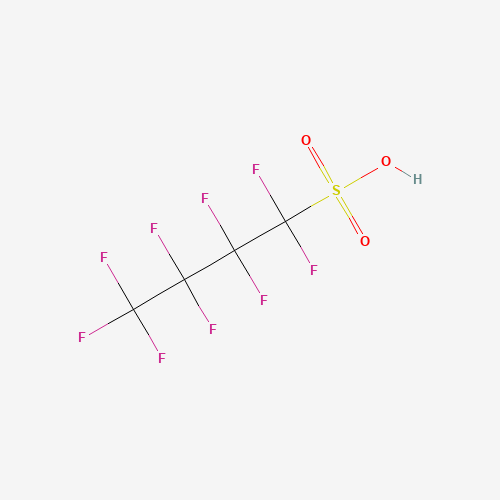
CAS375-73-5
分子式CF3(CF2)3SO3H
分子量300.1 g/mol g/mol
危化品
Perfluorobutanesulfonic acid is a perfluoroalkanesulfonic acid that is butane-1-sulfonic acid in which all of the hydrogens of the butyl group have been replaced by fluorines. It has a role as a surfactant.
科学粮草官-词典编辑部,修订于:2026-07-06
Toxicity
ToxicityBody Burden
[Table#8298]: IlN1YmplY3RzIiwiTnVtYmVyIiwiQWdlICh5ZWFycykiLCIlIFBvc2l0aXZlIgoiQ2hpbGRyZW4iLCIxNzAiLCI1LTYiLCIzMyIKIldvbWVuIiwiMzE3IiwiMjMtNDkiLCI0IgoiTWVuIiwiMjA0IiwiMTgtNjkiLCIxMyIK
Ecotoxicity Values
LC50; Species: Danio rerio (Zebra Danio) embryo, AB strain, 4 cell stage; Conditions: freshwater, static, 26 °C, pH 7.2-7.6; Concentration: 1500000 ug/L for 144 hr (95% confidence interval: 1100000-1900000 ug/L) /formulation/
Fate Summary
ATMOSPHERIC FATE: According to a model of gas/particle partitioning of semivolatile organic compounds in the atmosphere(1), perfluorobutanesulfonic acid, which has an estimated vapor pressure of 0.027 mm Hg at 25 °C(SRC), determined from a fragment constant method(2), is expected to exist solely as a vapor in the ambient atmosphere. Vapor-phase perfluorobutanesulfonic acid is degraded in the atmosphere by reaction with photochemically-produced hydroxyl radicals(SRC); the half-life for this reaction in air is estimated to be 115 days(SRC), calculated from its rate constant of 1.4X10⁻¹³ cu cm/molecule-sec at 25 °C(SRC) that was derived using a structure estimation method(2). Perfluorobutanesulfonic acid does not contain chromophores that absorb at wavelengths >290 nm(3) and, therefore, is...
Soil Adsorption / Mobility
Using a structure estimation method based on molecular connectivity indices(1), the Koc of perfluorobutanesulfonic acid can be estimated to be 180(SRC). According to a classification scheme(2), this estimated Koc value suggests that perfluorobutanesulfonic acid is expected to have moderate mobility in soil. The estimated pKa of perfluorobutanesulfonic acid is -3.31(3), indicating that this compound will exist in anion form in the environment and anions generally do not adsorb more strongly to soils containing organic carbon and clay than their neutral counterparts(4). The log Koc for perfluorobutanesulfonic acid in three sediments was reported as 1.42 in 23 sediments(5).
Environmental Biodegradation
AEROBIC: Using a closed-bottle test (OECD 301D), an inoculum from the Rhine River and incubated at 20 °C for 28 days in the dark perfluorobutanesulfonic acid starting at 73 mg/L was biodegraded <3%. Using a manometric respirometry test (OECD 301F) with activated sludge, 100 mg/L perfluorobutanesulfonic acid was biodegraded <1% in 40 days. In a fixed bed bioreactor test using Rhine River inoculum, perfluorobutanesulfonic acid did not biodegradable in the 28 day test run at room temperature in the dark(1).
Environmental Bioconcentration
Perfluorobutanesulfonic acid was not found to bioaccumulate in laboratory experiments in rainbow trout (Onchorynchus mykiss) with a reported BCF of 0.71(1). According to a classification scheme(2), this BCF suggests bioconcentration in aquatic organisms is low(SRC). The average log bioaccumulation factor in eel (Anguilla anguilla) was 1.26, sampled from 23 locations in The Netherlands(3).
Volatilization from Water / Soil
An estimated pKa of -3.31(1) indicates perfluorobutanesulfonic acid will exist entirely in the anion form at pH values of 5 to 9 and, therefore, volatilization from water and moist soil surfaces is not expected to be an important fate process(SRC). Perfluorobutanesulfonic acid is not expected to volatilize from dry soil surfaces(SRC) based upon an estimated vapor pressure of 0.027 mm Hg(SRC), determined from a fragment constant method(2).
Environmental Abiotic Degradation
The rate constant for the vapor-phase reaction of perfluorobutanesulfonic acid with photochemically-produced hydroxyl radicals has been estimated as 1.4X10⁻¹³ cu cm/molecule-sec at 25 °C(SRC) using a structure estimation method(1). This corresponds to an atmospheric half-life of about 115 days at an atmospheric concentration of 5X10+5 hydroxyl radicals per cu cm(1). Perfluorobutanesulfonic acid is not expected to undergo hydrolysis in the environment due to the lack of functional groups that hydrolyze under environmental conditions(2). Perfluorobutanesulfonic acid does not contain chromophores that absorb at wavelengths >290 nm(2) and, therefore, is not expected to be susceptible to direct photolysis by sunlight(SRC).
Environmental Water Concentrations
SURFACE WATER: Perfluorobutanesulfonic acid was detected in open ocean water at <1.6-60, <1.6 and <1.6 pg/L in 40 samples from the North Atlantic, 10 samples from the Middle Atlantic and 10 samples from the South Atlantic Ocean, respectively, samples were collected April, Oct and Nov of 2007(1). Perfluorobutanesulfonic acid was detected in 48 samples collected in August 2007 from the coastal waters of the German Bight at 3.38-17.7 ng/L(2). Perfluorobutanesulfonic acid was detected at 7.7, 2.8 and 2.3 ng/L in river water samples collected from the Glatt River at Schwerzenbach, Oberglatt and Rheinsfelden, Switzerland, respectively(3). Five streams flowing into Lake Shihwa, Korea had perfluorobutanesulfonic acid concentrations of <0.50-24.03 ng/L, concentrations in Lake Shihwa were <0.50-1...
Food Survey Values
Perfluorobutanesulfonic acid was sampled in food, tea and milk purchased in grocery stores in Oslo, Norway between Oct 2008 and Jan 2009, concentrations were (pg/g fresh weight): chicken meat (3.2), egg (2.0), fish sticks (5.0), salmon (2.2). All other products (lettuce, carrot, potato, cheese, margarine, milk, bread, strawberry jam, pork meat, beef, canned mackerel, cod, cod liver and tea) were listed at less than detection limit (detection limits varied)(1).
Milk Concentrations
[Table#8301]: IkNvdW50cnkiLCJOdW1iZXIgU2FtcGxlcyIsIiUgUG9zaXRpdmUiLCJDb25jbiAocGcvbUwiCiJKYXBhbiIsIjI0IiwiMCIsIjwxLjExIgoiTWFsYXlzaWEiLCIxMyIsIjgiLCI8MS4xMS0xNi41IgoiUGhpbGlwcGluZXMiLCIyNCIsIjEzIiwiPDEuMTEtMTcuNCIKIkluZG9uZXNpYSIsIjIwIiwiMCIsIjwxLjExIgoiVmlldG5hbSIsIjQwIiwiMTAiLCI8MS4xMS0zLjk4IgoiQ2FtYm9kaWEiLCIyNCIsIjgiLCI8MS4xMS00Ljg2IgoiSW5kaWEiLCIzOSIsIjUiLCI8MS4xMS04Ljg2Igo=
Ecotoxicity Excerpts
/OTHER TOXICITY INFORMATION/ A multigeneration toxicity test on Chironomus riparius was performed with the aim of investigating the evolutionary consequences of exposure to perfluoralkyl substances (perfluorooctane sulfonic acid, PFOS; perfluorooctanoic acid, PFOA; perfluorobutane sulfonate, PFBS). Six-hundred larvae were bred per treatment and per generation until emergence and egg deposition under a nominal concentration of 10 ug/L of contaminants. Newborn larvae were used to start the next generation. Evolution of genetic variability was evaluated along a total of 10 consecutive generations based on 5 microsatellite loci. Analysis of life-history traits (survival, sex ratio and reproduction) was also carried out. Rapid genetic variability reduction was observed in all treatments, inc...
Animal Concentrations
Perfluorobutanesulfonic acid was not detected (detection limit 0.1 ng/g wet weight) in northern fulmar (Fulmarus glacialis) and thick-billed murre (Uria lomvia) eggs sampled 1971-2009 from Prince Leopold Island, Nunavut, Canada; was detected in northern fulmar at 0.57 ng/g wet weight in 2011 and murre at 0.04 and 0.07 ng/g wet weight in 2010 and 2011, respectively; black guillemot (Cepphus grylle), black-legged kittiwake (Rissa tridactyla) and glaucous gull (Larus hyperboreus) eggs sampled in 2008 did not contain perfluorobutanesulfonic acid(1). Perfluorobutanesulfonoic acid was not detected (detection limit 2 pg/mL) in blood samples from 16 eider duck (Sommateria mollisima), collected from the Gulf of Gdansk in Feb 2003(2). Perfluorobutanesulfonic acid was not detected (detection limit...
Effluent Concentrations
[Table#8299]: IkxvY2F0aW9uIiwiSW5mbHVlbnQgKG5nL0wpIiwiRWZmbHVlbnQgKG5nL0wpIgoiRmFlbGlhbmRlbiIsIjMuOSIsIjQuMCIKIkJhc3NlcnNkb3JmIiwiMi42IiwiMS44IgoiRHVlYmVuZG9yZiIsIjUuOCIsIjcuMiIKIktsb3Rlbi1PcGZpa29uIiwiNy4zIiwiNy44IgoiTmllZGVyZ2xhdHQiLCIxLjMiLCIxLjEiCiJCdWVsYWNoIiwiMC42IiwiMi4yIgoiR2xhdHRmZWxkZW4iLCIyLjMiLCJub3QgZGV0ZWN0ZWQiCg==
Natural Pollution Sources
Perfluorobutanesulfonic acid does not occur naturally in the environment(1).
Atmospheric Concentrations
INDOOR AIR: Perfluorobutanesulfonic acid was not detected in air samples from a home in Edmonton, Canada sampled Sept 2008(1). Perfluorobutanesulfonic acid was not detected in 40 indoor air samples from Oslo, Norway households(2).
Fish/Seafood Concentrations
[Table#8300]: IkZpc2giLCJOdW1iZXIiLCJDb25jbiAobmcvZyB3ZXQvd3QpIgoiU2NhZCIsIjMiLCI8Ny41IgoiU2FuZCBmaXNoIiwiNyIsIjw2LjQiCiJKYWNrIG1hY2tlcmVsIiwiMyIsIjw1LjgiCiJSYWluYm93IHRyb3V0IiwiMyIsIjw2LjQiCiJTYXJkaW5lIiwiMyIsIjw2LjMiCg==
Artificial Pollution Sources
Perfluorochemicals like perfluorobutanesulfonic acid have been widely used since the 1950s in many industrial and consumer products, including protective coatings for fabrics and carpet, paper coatings, insecticide formulations, and surfactants(1). Perfluorobutanesulfonic acid may be a degradation product of perfluorooctanesulfonyl fluoride-derived materials that have previously been used as surfactants(2). Perfluorobutanesulfonic acid's production and use may result in its release to the environment through various waste streams(SRC).
Sediment/Soil Concentrations
SEDIMENT: Sediment samples from Resolute, Char and Amituk lakes on Cornwallis Island, Nunavut, Canada contained perfluorobutanesulfonic acid at <0.029-0.11, <1.1 and <0.046-0.068 ng/g dry weight, respectively(1). Perfluorobutanesulfonic acid was detected at <0.1-<1.1 ng/g dry weight (quantification limit 2.2 ng/g dry weight) in sediment samples from Kamo, Uji, Tenjin, Katsura and Osaka rivers, Japan; samples were collected Feb-March 2005 or Dec 2003(2).
Probable Routes of Human Exposure
Occupational exposure to perfluorobutanesulfonic acid may occur through inhalation and dermal contact with this compound at workplaces where perfluorobutanesulfonic acid is produced or used. Monitoring data indicate that the general population may be exposed to perfluorobutanesulfonic acid via inhalation of dust, ingestion of food and drinking water, and dermal contact with consumer products containing perfluorobutanesulfonic acid. (SRC)
Other Environmental Concentrations
Dust samples were collected from 102 homes and 10 daycare centers in North Carolina and Ohio from 2000 to 2001 from vacuum cleaner bags during the US Environmental Protection Agency's Children's Total Exposure to Persistent Pesticides and Other Persistent Organic Pollutants study, perfluorobutanesulfonic acid was detected in 33.0% of the samples at a mean, median and maximum concentration of 41.7, 9.11 and 1150 ng/g, respectively(1). Perfluorobutanesulfonic acid was not detected in dust or carpet samples from a home in Edmonton, Canada sampled Sept 2008(2). Perfluorobutanesulfonic acid was detected in 41 dust samples from Norwegian households at 0.17-9.8 ng/g(3).
Environmental Fate / Exposure Summary
Perfluorochemicals like perfluorobutanesulfonic acid have been widely used since the 1950s in many industrial and consumer products, including protective coatings for fabrics and carpet, paper coatings, insecticide formulations, and surfactants. Perfluorobutanesulfonic acid's production and use may result in its release to the environment through various waste streams. If released to air, an estimated vapor pressure of 0.027 mm Hg at 25 °C indicates perfluorobutanesulfonic acid will exist solely as a vapor in the atmosphere. Vapor-phase perfluorobutanesulfonic acid will be degraded in the atmosphere by reaction with photochemically-produced hydroxyl radicals; the half-life for this reaction in air is estimated to be 115 days. Perfluorobutanesulfonic acid does not contain chromophores th...
Effect Level
collection=toxvaldb&kind=^EL$
Lethal Dose
collection=toxvaldb&kind=^LD$
Screening Level
collection=toxvaldb&kind=^SL$
Benchmark Values
collection=toxvaldb&kind=^BV$
Toxicity Summary
IDENTIFICATION AND USE: Perfluorobutanesulfonic acid (PFBS) can be in the form of a colorless liquid or a corrosive solid. Esters of perfluoroalkanesulfonic acids are used as strong alkylating agents in preparative chemistry. HUMAN EXPOSURE AND TOXICITY: Children with asthma have been shown to have significantly different serum PFBS levels compared to children without asthma. Inhibitory potencies of four perfluoroalkylated substances on human and rat 11beta-HSD2 were tested, one of which was PFBS. PFBS showed the lowest potency for the inhibition of human and rat 11beta-HSD2 activities. In an in vitro study, PFBS did not generate ROS or DNA damage in HepG2 cells. PFBS inhibited PHA-induced IL-10 release and prevented LPS-induced I-kappaB degradation. ANIMAL STUDIES: PFBS modestly reduce...
RAIS Toxicity Values
Oral Subchronic Chronic Reference Dose Reference: PPRTV Current
Other Toxicity Values
collection=toxvaldb&kind=^Other$
Human Toxicity Excerpts
/ALTERNATIVE and IN VITRO TESTS/ ... COS-1 cells were transfected with mouse or human PPARalpha plasmids to investigate the effects of different Perfluoroalkylated substances (PFASs) on PPARalpha activation. Greater PPARalpha activity was induced by PFASs with longer chain lengths and sulphonates were more potent than carboxylates. Perfluorobutanesulfonic acid (PFBS) (mouse, 317 uM; human, 206 uM) was least potent at activating PPARalpha followed by perfluorooctane sulfonate (PFOS) (94 uM; 262 uM), perfluorohexane sulfonic acid (PFHxS) (76 uM; 81 uM), PFBA (51 uM; 75 uM), perfluoro n-hexanoic acid (PFHxA) (38 uM; 471 uM), perfluorodecyl acrylate (PFDA) (20 uM; human not active), perfluorooctanoic acid (PFOA) (6 uM; 16 uM) and perfluoro n-nonanoic acid (PFNA) (5 uM; 11 uM).
Non-Human Toxicity Values
LD50 Rat oral 430 mg/kg
Reference and Risk Values
collection=toxvaldb&kind=^RRV$
Non-Human Toxicity Excerpts
/LABORATORY ANIMALS: Developmental or Reproductive Toxicity/ Perfluorobutanesulfonate (PFBS) is a surfactant and degradation product of substances based on perfluorobutanesulfonyl fluoride. A two-generation reproductive rat study has been conducted with potassium PFBS (K(+)PFBS). Parental-generation (P) rats were dosed orally by gavage with 0, 30, 100, 300 and 1000 mg K(+)PFBS/kg/day for 10 weeks prior to and through mating (males and females), as well as during gestation and lactation (females only). First generation (F1) pups were dosed similarly, beginning at weaning. Second generation (F2) pups were not directly dosed but potentially exposed to PFBS through placental transfer and nursing, and the study was terminated 3 weeks after their birth. Endpoints evaluated included body weigh...
1 or Cancer Risk Level 1E-06
Fraction of Contaminant Absorbed Dermally from Soil: 0.1
Medium-Specific Concentration
collection=toxvaldb&kind=^MSC$
Antidote and Emergency Treatment
Advanced treatment: Consider orotracheal or nasotracheal intubation for airway control in the patient who is unconscious, has severe pulmonary edema, or is in severe respiratory distress. Positive-pressure ventilation techniques with a bag-valve-mask device may be beneficial. Consider drug therapy for pulmonary edema ... . Consider administering a beta agonist such as albuterol for severe bronchospasm ... . Monitor cardiac rhythm and treat arrhythmias as necessary ... . Start IV administration of D5W TKO /SRP: "To keep open", minimal flow rate/. Use 0.9% saline (NS) or lactated Ringer's (LR) if signs of hypovolemia are present. For hypotension with signs of hypovolemia, administer fluid cautiously. Watch for signs of fluid overload ... . Treat seizures with diazepam (Valium) or lorazepa...
Hazard Quotient Level 3 or Cancer Risk Level 1E-04
Fraction of Contaminant Absorbed Dermally from Soil: 0.1
USGS Health-Based Screening Levels for Evaluating Water-Quality
Reference: Smith, C.D. and Nowell, L.H., 2024. Health-Based Screening Levels for evaluating water-quality data (3rd ed.). DOI:10.5066/F71C1TWP









