


 一键配货
一键配货
化合物详情
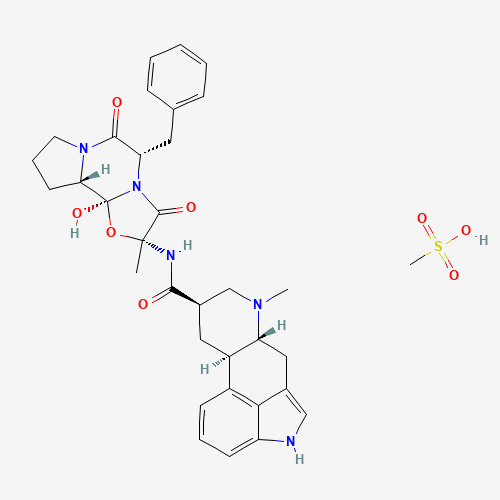
CAS6190-39-2
分子式C34H41N5O8S
分子量679.783 g/mol
非危品
Dihydroergotamine Mesylate can cause developmental toxicity according to state or federal government labeling requirements.
科学粮草官-词典编辑部,修订于:2026-07-06
Toxicity
ToxicitySymptoms
Convulsive ergotism can cause painful seizures and spasms, diarrhea, paresthesias, itching, headaches, nausea and vomiting. Usually the gastrointestinal effects precede the central nervous system effects. As well as seizures there can be hallucinations and mental effects including mania or psychosis. Gangrenous ergotism causes dry gangrene as a result of vasoconstriction induced in the more poorly vascularized distal structures, such as the fingers and toes. Symptoms include desquamation, weak periphery pulse, loss of peripheral sensation, edema and ultimately the death and loss of affected tissues. (L1920, L1933)
Treatment
Treatment for ergotism consists of vasodilators, anticoagulants and low molecular weight dextrans. If necessary, a sympathetic nerve blockade may be carried out, such as brachial plexus blockade. Temporary sedation (e.g. haloperidol) will be necessary in hallucination and diazepam is used for convulsions. There is no specific antidote. (L1921, L1933)
Lethal Dose
collection=toxvaldb&kind=^LD$
Health Effects
Ingestion of ergoline alkaloids is known to cause the disease ergotism. Ergotism occurs in two forms, gangrenous and convulsive, likely depending on the different kinds and amounts of ergoline alkaloids present. (A2913, L1933)
Exposure Routes
Intravenous (L1362); Nasal (L1362). Interpatient variable and may be dependent on the administration technique
Toxicity Summary
Two theories have been proposed to explain the efficacy of 5-HT<sub>1D</sub> receptor agonists in migraine: 1) activation of 5-HT<sub>1D</sub> receptors located on intracranial blood vessels, including those on arterio-venous anastomoses, leads to vasoconstriction, which correlates with the relief of migraine headache and 2) activation of 5-HT<sub>1D</sub> receptors on sensory nerve endings of the trigeminal system results in the inhibition of pro-inflammatory neuropeptide release.
Carcinogen Classification
No indication of carcinogenicity to humans (not listed by IARC).
Drug Induced Liver Injury
Reference: DOI:10.1016/j.drudis.2011.05.007
Effects During Pregnancy and Lactation
◉ Effects on Lactation and Breastmilk









