


 一键配货
一键配货
化合物详情
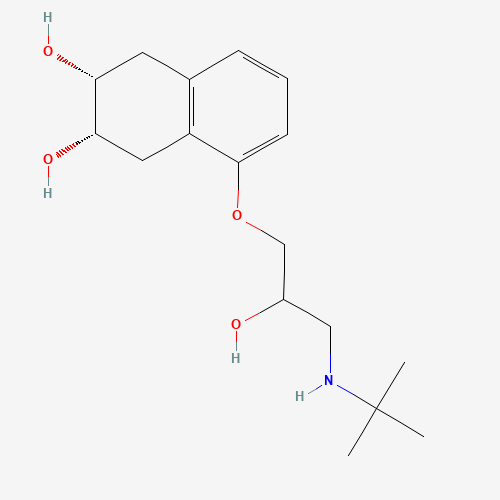
CAS42200-33-9
分子式C17H27NO4
分子量309.4 g/mol
危化品
Nadolol is a nonselective beta adrenal receptor blocker that is used to lower blood pressure. Nonselective beta adrenal receptor blockers may no longer be first line in the treatment of hypertension as newer generations of beta adrenal receptor blockers have higher selectivity and offer better rates of adverse effects. Nadolol was granted FDA approval on 10 December 1979.
科学粮草官-词典编辑部,修订于:2026-07-06
Toxicity
ToxicityBody Burden
Nadolol is distributed into milk /in humans/.
Fate Summary
ATMOSPHERIC FATE: According to a model of gas/particle partitioning of semivolatile organic compounds in the atmosphere(1), nadolol, which has an estimated vapor pressure of 9.9X10⁻¹¹ mm Hg at 25 °C(SRC), determined from a fragment constant method(2), is expected to exist solely in the particulate phase in the ambient atmosphere. Particulate-phase nadolol may be removed from the air by wet and dry deposition(SRC).
Soil Adsorption / Mobility
The Koc of nadolol is estimated as 60(SRC), using a log Kow of 0.71(1) and a regression-derived equation(2). According to a classification scheme(3), this estimated Koc value suggests that nadolol is expected to have high mobility in soil.
Environmental Bioconcentration
An estimated BCF of 3 was calculated for nadolol(SRC), using a log Kow of 0.71(1) and a regression-derived equation(2). According to a classification scheme(3), this BCF suggests the potential for bioconcentration in aquatic organisms is low(SRC).
Volatilization from Water / Soil
The Henry's Law constant for nadolol is estimated as 1.4X10⁻¹⁴ atm-cu m/mole(SRC) using a fragment constant estimation method(1). This Henry's Law constant indicates that nadolol is expected to be essentially nonvolatile from water surfaces(2). Nadolol's Henry's Law constant indicates that volatilization from moist soil surfaces is not expected to occur(SRC). Nadolol is not expected to volatilize from dry soil surfaces(SRC) based upon an estimated vapor pressure of 9.9X10⁻¹¹ mm Hg(SRC), determined from a fragment constant method(3).
Environmental Abiotic Degradation
Nadolol is not expected to undergo hydrolysis in the environment due to the lack of hydrolyzable functional groups(1) nor to directly photolyze due to the lack of absorption in the environmental UV spectrum (>290 nm). UV maximum values of 270 and 278 nm have been measured for nadolol in methanol(2). A pKa of 9.67 has been reported(2) indicating that this compound will exist primarily, if not completely, as the protonated species at environmental pH values of 5 to 9(SRC).
Environmental Water Concentrations
Nadolol was detected at concentrations of <0.005 to 0.009 ug/l in German surface waters(1).
Milk Concentrations
Nadolol is distributed into milk /in humans/.
Effluent Concentrations
Nadolol was detected at concentrations of <0.025 to 0.29 ug/l in German sewage effluents(1).
Artificial Pollution Sources
Nadolol's production and use as a pharmaceutical drug(1) may result in its release to the environment through various waste streams(SRC).
Probable Routes of Human Exposure
Occupational exposure to nadolol may occur through inhalation of dust and dermal contact with this compound at workplaces where nadolol is produced or used. The general population may be exposed to nadolol via ingestion of medication and dermal contact with this compound and other products containing nadolol. (SRC)
Environmental Fate / Exposure Summary
Nadolol's production and use as a pharmaceutical drug may result in its release to the environment through various waste streams. If released to air, an estimated vapor pressure of 9.9X10⁻¹¹ mm Hg at 25 °C indicates nadolol will exist solely in the particulate phase in the ambient atmosphere. Particulate-phase nadolol will be removed from the atmosphere by wet and dry deposition. If released to soil, nadolol is expected to have high mobility based upon an estimated Koc of 60. Volatilization from moist soil surfaces is not expected to be an important fate process based upon an estimated Henry's Law constant of 1.4X10⁻¹⁴ atm-cu m/mole. Nadolol is not expected to volatilize from dry soil surfaces based upon its vapor pressure. If released into water, nadolol is not expected to adsorb to su...
Interactions
High doses of nadolol may potentiate and prolong the effects of neuromuscular blocking agents such as tubocurarine chloride.
Hepatotoxicity
Likelihood score: E (unlikely cause of clinically apparent liver injury).
Adverse Effects
Severe hypotension, bronchospasm, and allergic reactions are rare but life-threatening adverse effects, often necessitating immediate emergency treatment.
Toxicity Summary
Heart failure is typically managed with cardiac glycosides and diuretics. Bronchospasm is treated with nebulized β-agonists, with consideration that higher than usual or multiple doses may be required. In cases of β-blocker–induced anaphylaxis, a lower-than-usual dose of epinephrine is administered, as the unopposed α-receptor effect can lead to coronary vasoconstriction and paradoxical hypertension.
Human Toxicity Excerpts
/HUMAN EXPOSURE STUDIES/ The effects of short-term nadolol administration on the reactive oxygen species (ROS) generation by polymorphonuclear leukocytes and mononuclear cells /was studied/ in 8 normal subjects. At a oral dose of 40 mg/day for 5 days, nadolol produced a decrease in the ROS generation by leukocytes. ROS generation by polymorphonuclear leukocytes decreased by 38% from 134 +/- 44 mV at baseline to 83 +/- 34 mV after 5 days (p = 0.005), and ROS generation by mononuclear cells decreased by 33% from 174 +/- 69 mV at baseline to 117 +/- 55 mV after 5 days (p = 0.015). A significant reduction in linoleic acid oxidation was reflected by the lower levels of 9- and 13- hydroxy-octadecadienoic acid after 5 days. There was no change in the plasma thiobarbituric acid-reacting substan...
Drug Induced Liver Injury
References: DOI:10.1016/j.drudis.2019.09.022
Non-Human Toxicity Values
LD50 Rat oral 5,300 mg/kg
Non-Human Toxicity Excerpts
/LABORATORY ANIMALS: Developmental or Reproductive Toxicity/ Reproduction studies in rats using nadolol have not revealed evidence of impaired fertility.
Effects During Pregnancy and Lactation
Relevant published information on the effects of beta-blockade or nadolol during normal lactation was not found as of the revision date. A study in 6 patients with hyperprolactinemia and galactorrhea found no changes in serum prolactin levels following beta-adrenergic blockade with propranolol.
USGS Health-Based Screening Levels for Evaluating Water-Quality
Reference: Smith, C.D. and Nowell, L.H., 2024. Health-Based Screening Levels for evaluating water-quality data (3rd ed.). DOI:10.5066/F71C1TWP









