


 一键配货
一键配货
化合物详情
CAS3922-90-5
分子式C35H61NO12
分子量687.86 g/mol g/mol
非危品
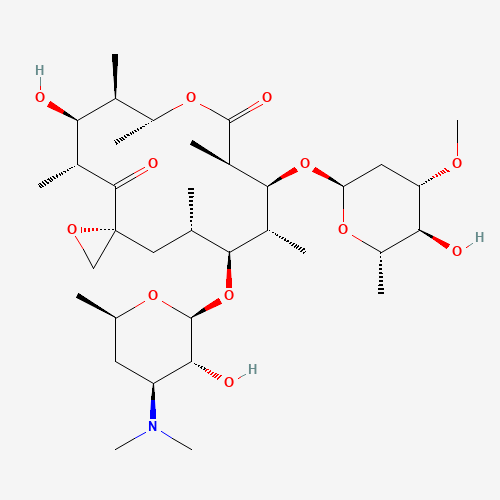
Oleandomycin is a member of oleandomycins. It is functionally related to an oleandolide. It is a conjugate base of an oleandomycin(1+).
科学粮草官-词典编辑部,修订于:2026-07-06
Toxicity
ToxicityFate Summary
ATMOSPHERIC FATE: Oleandomycin absorbs light at wavelengths >290 nm (UV max = 286-289 nm(1)) and therefore may be susceptible to direct photolysis by sunlight(2).
Soil Adsorption / Mobility
The Koc of oleandomycin is estimated as 200(SRC), using a log Kow of 1.69(1) and a regression-derived equation(2). According to a classification scheme(3), this estimated Koc value suggests that oleandomycin is expected to have moderate mobility in soil. The pKa of oleandomycin is 8.84 (tertiary amine)(1), indicating that this compound will exist primarily as a cation in the environment, and cations generally have lower mobility in soils than their neutral counterparts(4).
Environmental Bioconcentration
An estimated BCF of 11 was calculated for oleandomycin(SRC), using a log Kow of 1.69(1) and a regression-derived equation(2). According to a classification scheme(3), this BCF suggests the potential for bioconcentration in aquatic organisms is low(SRC).
Volatilization from Water / Soil
A measured pKa of 8.84 (tertiary amine)(1) indicates that oleandomycin will exist primarily as a cation in the environment. Volatilization of oleandomycin from moist soil or water surfaces is not expected to be an important fate process(SRC) since cations do not volatilize.
Environmental Abiotic Degradation
Oleandomycin contains hydrolyzable functional groups and therefore may undergo hydrolysis in the environment(1); however, a rate constant could not be estimated for this structure. Oleandomycin absorbs light at wavelengths >290 nm (UV max = 286-289 nm(2)) and therefore may be susceptible to direct photolysis by sunlight(1).
Natural Pollution Sources
Oleandomycin consists of a single component produced by Streptomyces antibioticus(1).
Artificial Pollution Sources
Oleandomycin's production and use as a veterinary antibacterial drug(1,2) may result in its release to the environment through various waste streams(SRC).
Probable Routes of Human Exposure
Occupational exposure to oleandomycin may occur through dermal contact with this compound at workplaces where oleandomycin is produced or used. Exposure to oleandomycin among the general population may be limited to those who administer this substance to animals. (SRC)
Environmental Fate / Exposure Summary
Oleandomycin's production and use as a veterinary antibacterial drug may result in its release to the environment through various waste streams. Oleandomycin is produced by Streptomyces antibioticus. Oleandomycin absorbs light at wavelengths >290 nm (UV max = 286-289 nm) and therefore may be susceptible to direct photolysis by sunlight. If released to soil, oleandomycin is expected to have moderate mobility based upon an estimated Koc of 200. The pKa of oleandomycin is 8.84, indicating that this compound will exist primarily as a cation in the environment, and cations generally have lower mobility in soils than their neutral counterparts. Volatilization from moist soil surfaces is not expected to be an important fate process because cations do not volatilize. Oleandomycin is not expecte...
Interactions
The combination effect of tetracycline (TC) and oleandomycin (OM) on acute infection of mice with four strains of Staphylococcus aureus including TC or OM resistant ones was examined by the quantitative determination of protective potencies of single and combined drugs. The grade of synergism was expressed by the synergistic ratio (SR), a ratio of experimentally determined potency of the combined drug over a hypothetical potency in which additive effect of the both drugs is assumed. With 3 out of the 4 strains of S. aureus synergism between TC and OM or triacetyloleandomycin (TAO) was demonstrated by the determination of the 50% effective dose and by statistical examination of the SR. The grade of synergistic protection by these drugs varied with the strains infected and it did not depe...
Lethal Dose
collection=toxvaldb&kind=^LD$
Non-Human Toxicity Excerpts
/OTHER TOXICITY INFORMATION/ Rats have been treated with several derivatives of the erythromycin, erythralosamine or oleandomycin series, in order to compare their ability to induce cytochrome P-450 and to form stable 456 nm-absorbing cytochrome P-450 metabolite complexes. The data obtained confirm that the cytochromes P-450 induced in rats by various macrolides are similar to that induced by pregnenolone 16 alpha-carbonitrile: the cytochrome P-450 IIIA1 isozyme. ...
Antidote and Emergency Treatment
/SRP:/ Advanced treatment: Consider orotracheal or nasotracheal intubation for airway control in the patient who is unconscious, has severe pulmonary edema, or is in severe respiratory distress. Positive-pressure ventilation techniques with a bag valve mask device may be beneficial. Consider drug therapy for pulmonary edema ... . Consider administering a beta agonist such as albuterol for severe bronchospasm ... . Monitor cardiac rhythm and treat arrhythmias as necessary ... . Start IV administration of D5W /SRP: "To keep open", minimal flow rate/. Use 0.9% saline (NS) or lactated Ringer's if signs of hypovolemia are present. For hypotension with signs of hypovolemia, administer fluid cautiously. Watch for signs of fluid overload ... . Treat seizures with diazepam or lorazepam ... . Use...









