


 一键配货
一键配货
简介
基本信息
技术文档
上下游信息
相关文章
评价
咨询
售后
产品简介
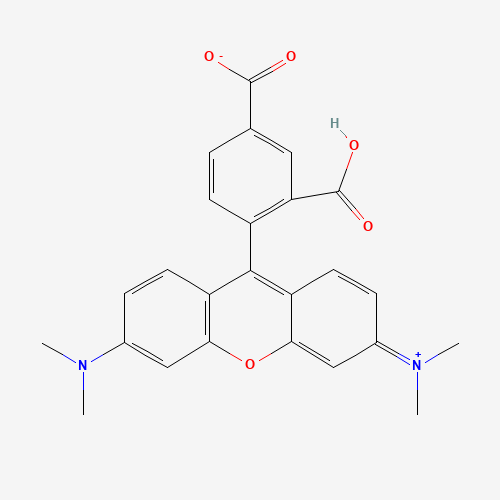
Fluorescent Dye Carboxylic Acids and Their Succinimidyl Esters Succinimidyl esters are proven to be the best reagents for amine modifications because the amide bonds that are formed are essentially identical to, and as stable as the natural peptide bonds. These reagents are generally stable and show good reactivity and selectivity with aliphatic amines. There are few factors that need be considered when SE compounds are used for conjugation reaction: 1). Solvents:For the most part, reactive dyes are hydrophobic molecules and should be dissolved in anhydrous dimethylformamide (DMF) or dimethylsulfoxide (DMSO). 2). Reaction pH:The labeling reactions of amines with succinimidyl esters are strongly pH dependent. Amine-reactive reagents react with non-protonated aliphatic amine groups, including the terminal amines of proteins and the e-amino groups of lysines. Thus amine acylation reactions are usually carried out above pH 7.5. Protein modifications by succinimidyl esters can typically be done at pH 7.5-8.5, whereas isothiocyanates may require a pH 9.0-10.0 for optimal conjugations. 3).Reaction Buffers:Buffers that contain free amines such as Tris and glycine and thiol compounds must be avoided when using an amine-reactive reagent. Ammonium salts (such as ammonium sulfate and ammonium acetate) that are widely used for protein precipitation must also be removed (such as viadinlysis) before performing dye conjugations. 4). Reaction Temperature:Most conjugations are done at room temperature. However, either elevated or reduced temperature may be required for a particular labeling reaction. Features and Biological Applications 5-TAMRA is the purified single isomer of 5(6)-TAMRA. It is widely used to label peptides and proteins. It is preferred for some complicated biological applications where reproducibility is more critical than material cost since the minor positional difference between 5-TAMRA and 6-TAMRA might affect some biological properties of the underlying conjugates. Product parameter Ex(nm):541 Em(nm):568 References 1. Evans NA, et al. (2001). Visualizing differences in ligand-induced beta-arrestin-GFP interactions and trafficking between three recently characterized G protein-coupled receptors. J Neurochem77, 476-85. 2. Hahn, M., et al., Influence of fluorophor dye labels on the migration behavior of polymerase chain reaction—amplified short tandem repeats during denaturing capillary electrophoresis.Electrophoresis2001, 22, 2691-700. 3. Yoo H and Juliano RL (2000). Enhanced delivery of antisense oligonucleotides with fluorophore- conjugated PAMAM dendrimers. Nucleic Acids Res28, 4225-31. Fluorescent Dye Carboxylic Acids and Their Succinimidyl Esters Succinimidyl esters are proven to be the best reagents for amine modifications because the amide bonds that are formed are essentially identical to, and as stable as the natural peptide bonds. These reagents are generally stable and show good reactivity and selectivity with aliphatic amines. There are few factors that need be considered when SE compounds are used for conjugation reaction: 1). Solvents:For the most part, reactive dyes are hydrophobic molecules and should be dissolved in anhydrous dimethylformamide (DMF) or dimethylsulfoxide (DMSO). 2). Reaction pH:The labeling reactions of amines with succinimidyl esters are strongly pH dependent. Amine-reactive reagents react with non-protonated aliphatic amine groups, including the terminal amines of proteins and the e-amino groups of lysines. Thus amine acylation reactions are usually carried out above pH 7.5. Protein modifications by succinimidyl esters can typically be done at pH 7.5-8.5, whereas isothiocyanates may require a pH 9.0-10.0 for optimal conjugations. 3).Reaction Buffers:Buffers that contain free amines such as Tris and glycine and thiol compounds must be avoided when using an amine-reactive reagent. Ammonium salts (such as ammonium sulfate and ammonium acetate) that are widely used for protein precipitation must also be removed (such as viadinlysis) before performing dye conjugations. 4). Reaction Temperature:Most conjugations are done at room temperature. However, either elevated or reduced temperature may be required for a particular labeling reaction. Features and Biological Applications 5-TAMRA is the purified single isomer of 5(6)-TAMRA. It is widely used to label peptides and proteins. It is preferred for some complicated biological applications where reproducibility is more critical than material cost since the minor positional difference between 5-TAMRA and 6-TAMRA might affect some biological properties of the underlying conjugates. Product parameter Ex(nm):541 Em(nm):568 References 1. Evans NA, et al. (2001). Visualizing differences in ligand-induced beta-arrestin-GFP interactions and trafficking between three recently characterized G protein-coupled receptors. J Neurochem77, 476-85. 2. Hahn, M., et al., Influence of fluorophor dye labels on the migration behavior of polymerase chain reaction—amplified short tandem repeats during denaturing capillary electrophoresis.Electrophoresis2001, 22, 2691-700. 3. Yoo H and Juliano RL (2000). Enhanced delivery of antisense oligonucleotides with fluorophore- conjugated PAMAM dendrimers. Nucleic Acids Res28, 4225-31.
基本信息 ⸢ 查看详细信息 ⸥
中文名称
5-羧基四甲基罗丹明
英文名称
5-TAMRA
中文别名
-
英文别名
2-[3,6-bis(dimethylamino)xanthenium-9-yl]-5-carboxybenzoate | 2-(3,6-Bis(dimethylamino)xanthylium-9-yl)-5-carboxybenzoate | 5(6)-TAMRA Acid | BCP20413 | AKOS032949753 | BP-23469 | 5-Carboxytetramethyl Rhodamine | AKOS016000326 | DTXSID20376330 | F12248 |
CAS号
91809-66-4
分子式
C25H22N2O5
分子量
430.45 g/mol
精确质量
≥97%
PSA
92.900 Ų
Logp
3.200
上下游信息
「暂无上下游信息」
相关文章
「暂无相关文章」
用户评价
加载中...
商品咨询
温馨提示:
因厂家可能临时调整产品规格、价格、库存、参数等信息且不另行通知,同时每位用户的咨询时间、采购需求存在差异,平台回复内容仅在一定时期内具有参考价值。由此给您带来的不便,敬请谅解,感谢您的理解与支持!最新详细信息请咨询在线客服,一切以客服实时回复为准!
售后服务
收到货品请及时核对数量、外观及产品信息,如遇破损、错发、质量异常等问题,欢迎随时联系我们。
服务热线:400-6226-992 ,我们将第一时间为您处理,感谢您的支持与信任!
5-羧基四甲基罗丹明 100mg
品牌:阿拉丁
货号:C272928-100mg
级别: ≥97%
货期:30天
已售 174 件
¥
353
.88
¥
424
.66
配送至: 请选择地址
运费:0 元
规格:
100mg
数量
精选好物
扫一扫









